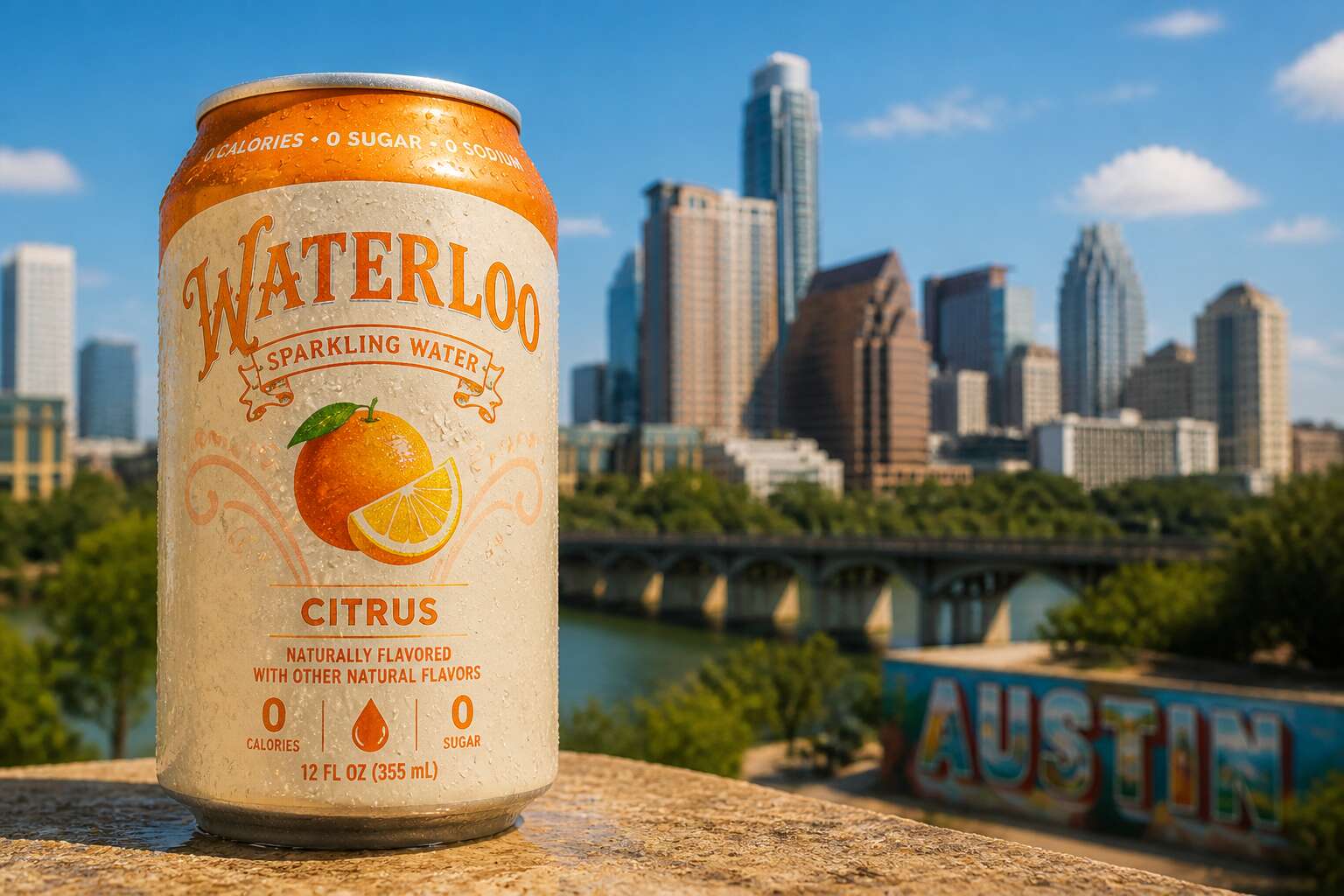
The Birth of Waterloo Sparkling Water
Founding Year and Founders
Waterloo Sparkling Water began in 2017, founded in Austin, Texas by Jeff Klouda and Jeremy Berman. Klouda had spent two decades in beverage manufacturing, while Berman ran the operational side. They shared a cramped office on Waterloo Road, and the street name eventually became the brand name.
Their early rules were strict:
- No artificial sweeteners.
- No chemically derived natural flavors.
- Only fruit essences from real produce.
That restraint defined the product from day one! When someone asks where is waterloo sparkling water from, the real answer is that small Austin office, where two founders decided a sparkling water should taste like the fruit itself, not a facsimile of it.
The City of Origin in Texas
Where is Waterloo sparkling water from? The answer begins with Austin’s underground water system. The Edwards Aquifer filters through limestone, lending a subtle minerality that shaped the brand’s entire approach. Texas heat creates constant demand for hydration without sugary residue.
The city itself acted as a tasting lab. Farmers markets overflowed with seasonal fruit, offering endless inspiration:
- Peach from Stonewall.
- Blackberry from East Texas.
- Citrus from the Rio Grande Valley.
That produce defined the fruit essences. Austin’s tap water, a blend of lake and aquifer sources, taught the team what a clean base truly tastes like.
Initial Product Line and Mission
The first four Waterloo flavors did not come from a focus group. Black Cherry, Lemon Lime, Grapefruit, and Orange Vanilla were chosen because each one carried a distinct Texas memory. The mission was simple: prove that sparkling water could taste like the fruit itself, not a synthetic approximation!
The team rejected added sugars and artificial sweeteners, a decision I appreciate every time a can delivers real fruit taste. Instead, they built the initial product line around truthfulness. For anyone asking where is waterloo sparkling water from, the answer was in the can. The testing process was methodical:
- Each flavor started with whole fruit, not extracted compounds.
- Small batches were tested at backyard gatherings where guests guessed flavors blindly.
- Any batch resembling candy more than fruit was discarded.
That directness defined the brand. The goal was to capture Texas fruit in a clean, refreshing format, and the initial product line delivered.
Evolution from Startup to Popular Brand
Waterloo now sits in thousands of stores nationwide, a long way from its first cooler at a single Austin grocer. Distribution started with independent grocers across Texas, where customers tasted the difference between a watery club soda and real fruit flavour. That local presence built momentum. National retail chains followed.
The evolution from startup to popular brand followed three distinct phases:
- Regional distribution across Texas, establishing a loyal customer base
- Expansion into neighbouring states through specialty food stores
- National availability after major retailers noticed consistent repeat purchases
For anyone asking where is waterloo sparkling water from, I find the answer now has more nuance. The brand remains based in Austin, even as production scaled to meet nationwide demand. Where is waterloo sparkling water from today? The fruit-forward recipe is unchanged, but the cans travel far beyond Texas.
Manufacturing and Bottling Locations
Headquarters and Corporate Operations
For anyone asking where is waterloo sparkling water from, the answer begins in Austin, Texas, but the physical production tells a more layered story. The company does not own a single cavernous factory. Instead, Waterloo contracts with regional bottling partners across the United States, a common approach for beverage brands that want to scale without sinking capital into cement and steel.
This strategy keeps the corporate footprint lean. Waterloo’s headquarters remains in Austin, where a compact team manages marketing, flavor development, and distribution partnerships. The actual canning happens closer to regional hubs, shortening the distance between the filling line and your grocery shelf. That proximity matters for flavor integrity.
What this means for freshness:
- Shorter transit times from bottler to retailer
- Less warehouse storage before purchase
- Consistent rotation of stock at stores
So while the brand’s soul is Texan, its operational arms reach across state lines, quietly keeping the supply chain moving.
Bottling Plant Locations Across the U.S.
To answer where is waterloo sparkling water from more completely, you must look beyond Texas. The brand contracts with four regional bottling partners, each operating within a specific corridor of the United States.
- A Dallas partner serves Texas and the Southwest
- A Los Angeles facility handles the West Coast
- A Chicago plant covers the Midwest
- A New Jersey operation manages the Northeast
These partners receive flavour essences shipped from Austin headquarters. Local water is filtered, carbonated, and sealed under strict specifications. The mineral character of the water differs subtly from region to region. Most drinkers never notice. Those who do say the Texas version carries a harder mouthfeel than its coastal counterparts. It is a quiet variation, invisible on the label, yet present in every sip.
Partnerships with Contract Beverage Producers
The architectural secret behind Waterloo’s national footprint is simple. It is a network of commercial alchemists. When you ask where is waterloo sparkling water from, the most accurate answer is wherever fresh filtration meets a contract. The brand does not own a single bottling line. Instead, they hand their recipes to regional producers who run the equipment with military precision.
Each partner adheres to a strict playbook. The flavor essences depart from Austin with batch codes. The local water gets filtered through reverse osmosis. Carbonation levels are checked at multiple stages. The result is a product that passes internal audits without fail. This allows the company to scale without the crippling cost of factory ownership. That financial freedom gets spent on new flavors and marketing stunts.
This strategy has notable advantages. It also carries hidden risks. A contract producer handles dozens of other brands. Quality can drift if the team on the floor gets distracted. Waterloo counters this with surprise inspections and blind taste tests. They ship a “golden sample” from Austin to every facility. The producers must match that baseline or face a rejected batch.
– The partnership model keeps capital costs low.
– It allows for rapid geographic expansion.
– It puts a premium on the strength of the contract terms.
– It requires constant vigilance from the Austin quality team.
So where is waterloo sparkling water from in practice? It comes from a partnership built on trust and a shared obsession with dissolved solids. The bottles in your hand are the sum of that collective effort. It is a system that turns tap water into a premium experience, one regional sip at a time.
Quality Control and Production Standards
Every facility operates under a shared obsession with precision. The question of where is waterloo sparkling water from finds its answer in the laboratory reports that accompany each batch. Production standards demand dissolved solids below five parts per million. Any deviation triggers an automatic rejection protocol.
The sensory panel in Austin maintains a library of reference samples. Each facility ships finished product back for comparative analysis. This loop creates a closed circuit of accountability.
- Water hardness is tested before filtration.
- Carbonation volume is measured at three distinct stages.
- pH levels must land between 3.8 and 4.2.
- Flavor intensity is verified against a spectrophotometer reading.
The system works because the standards live on paper, not in memory. Workers do not approximate. They measure. That discipline is the real origin story.
Local Sourcing of Carbonated Water Components
The question of where is waterloo sparkling water from is answered at the municipal tap. Each facility draws from its regional aquifer, and that water carries a mineral signature of its county. Carbon dioxide comes from regional gas suppliers.
I like to trace a single can in Ohio. It uses water from a nearby treatment plant and carbon dioxide from a supplier within the same state. The filled can is loaded onto a truck that never crosses more than one border. Every facility maintains this arrangement, so the answer shifts slightly with each region.
- Water comes from the host city’s municipal supply.
- Carbon dioxide is purchased from regional gas providers.
- Flavor concentrates are blended in Austin and shipped to each plant.
Local sourcing is a logistical necessity. Where is waterloo sparkling water from? The answer is: the water comes from the ground beneath the plant.
Water Source and Flavor Ingredients
Base Water Sourcing: Municipal vs. Spring
Water is a storyteller, and in the case of Waterloo, the tale begins with the source. Most people cannot tell the difference between municipal and spring water in a blind tasting, yet the choice dictates the entire mineral profile of the final sip. This distinction is not a marketing trifle, it is the foundational character of the beverage. For a sparkling water, the base liquid must be neutral, allowing the fruit essences to take the lead without interference.
The company primarily relies on purified municipal water, a decision that diverges from the rustic imagery many competitors paint. Municipal sourcing, after rigorous filtration, offers a consistent and reliable canvas. It undergoes reverse osmosis to strip away impurities, leaving a clean slate that the flavor team can then build upon.
– It is a process of reduction, not addition.
– The water enters as a blank page.
– It leaves the system as a perfect carrier for botanicals.
In contrast, spring water carries a signature of its underground journey, a specific balance of calcium and magnesium that varies by season. That variability, while romantic, can compromise the uniformity of a product found on shelves from Austin to Johannesburg. By choosing municipal as the base, Waterloo ensures that the Calgary sparkle you taste today will be identical next year. The flavor ingredients, often natural essences, are then suspended in this perfectly clean medium, allowing for a crisp profile that is both predictable and refreshingly pure. So when you ask where is waterloo sparkling water from, the answer lies in that dedicated pursuit of a neutral beginning.
Filtration and Purification Processes
Municipal water sounds mundane, yet it plays a specific role in Waterloo’s clean taste. The purification process is a triple pass: reverse osmosis, activated carbon filtration, and ultraviolet exposure. Each step strips away chlorine, heavy metals, and volatile compounds, leaving a neutral base that lets fruit essences lead without interference.
- Reverse osmosis catches dissolved solids.
- Activated carbon neutralises smell and taste contaminants.
- Ultraviolet light finishes the job with zero chemical residue.
Only then do natural flavors arrive! Waterloo blends fruit essences, derived from real botanicals, into this purified water under pressure. The outcome is a clean sparkle with no mineral interference. So if you ever wonder where is waterloo sparkling water from, the answer is a meticulous filtration and flavor infusion process, not a scenic spring.
Natural Flavor Extracts and Essences
We start with municipal water, the same supply that runs through American taps. This choice is deliberate. A spring might seem charming, but it cannot guarantee consistency. Municipal water is tested, treated, and predictable. It gives us a neutral base, free from the unpredictable minerals found in natural sources.
The flavors come next. We use natural extracts and essences, derived from real botanicals. These are not artificial compounds. They are captured through cold pressing or steam distillation, preserving the character of the fruit or herb.
- Citrus oils from peels
- Berry essences from crushed fruit
- Botanical extracts from leaves and roots
So when someone wonders where is waterloo sparkling water from, the answer is a system built on control, not chance. Every bottle reflects that.
Sweetener-Free Formulation
Consumers often assume flavored sparkling water needs sugar or artificial sweeteners to taste good. Waterloo proves otherwise. The carbonated water carries flavor through a sweetener-free formulation that relies entirely on the quality of its ingredients.
Answering where is waterloo sparkling water from means understanding what isn’t in the can. No syrups. No stevia. No sucralose. Each drink uses real fruit and botanical components to create depth without a single gram of sugar.
The base water and flavoring work together directly. Without sweeteners masking flaws, the source must be clean and the extracts precise. This approach delivers a crisp finish:
- Zero calories
- Zero sweeteners
- Full flavor from natural ingredients
This formulation demands higher production standards. When a brand strips away sweetness, every sip lays bare the water and flavor quality. That is where is waterloo sparkling water from: a commitment to restraint.
Carbonation Methods and Bubble Profile
The very question of where is waterloo sparkling water from extends beyond a zip code; it is a question of liquid geology. The base water, stripped to its essential self through meticulous filtration, serves as a blank canvas. The flavoring components are not muddled extracts but precise essences from real fruit, designed to interact with the carbonation. Whether it is a Texas peach or a citrus blend, the ingredient list reads like a farmer’s market receipt, not a chemistry lab report.
Carbonation is not a mere afterthought; it is the structural pillar of the drinking experience. The infusion process creates bubbles that are assertive enough to carry the flavor profile but refined enough to avoid a harsh, burning sensation. This balance yields a distinct bubble profile:
1. A vigorous initial fizz on the pour.
2. A medium-sized bubble that sustains its presence.
3. A clean, sharp bite that dissipates without a lingering chemical aftertaste.
This precise textural element complements the purity of the water. The effervescence works in tandem with the flavor essences rather than masking them. The result is a sparkling water that feels intentional. The crafting of these bubbles is part of the answer for those asking where is waterloo sparkling water from, defining the brand’s character as much as its origin story.
Ingredient Transparency and Labeling
Few beverage companies print the full provenance on a can. A label that says “carbonated water” and “natural flavor” usually invites guesswork. The question of where is waterloo sparkling water from gets a direct answer: municipal water, filtered through reverse osmosis, paired with fruit essences from the named ingredient. No mystery blends.
Ingredient transparency runs deep. The label lists exactly what we put in, which is two things. There is no sweetener, no preservative, no “proprietary essence blend.”
The can reveals three facts:
- The base water source category.
- The specific fruit or citrus essence.
- The absence of any caloric additives.
That level of honesty is rare in the fizzy aisle. Most rivals hide behind vague terms and trade secrets. Waterloo treats the can like a receipt, and the answer to where is waterloo sparkling water from is printed right there for anyone who cares to read it.
Distribution Network and Market Reach
Retail Availability in Grocery Chains
When consumer demand pushes a beverage brand into the national spotlight, the supply chain must keep pace. Waterloo sparkling water now appears in more than 30,000 retail outlets across the United States, according to recent industry tracking from Beverage Digest. Building this footprint took years of deliberate retail negotiations.
Retail availability in grocery chains varies by region. A sampling of prominent carriers includes:
– Whole Foods Market
– Kroger
– Publix
– Target
– Walmart Supercenters
Placement depth differs considerably. In the Southeast, Publix offers generous cold-box positioning. On the West Coast, Safeway features a rotating seasonal assortment. The market reach also extends to independent grocers and specialty organic markets.
For South African readers curious about where is waterloo sparkling water from, the answer is rooted in Austin, Texas, yet the brand’s distribution has spread far beyond state lines. Strategic partnerships with regional distributors have enabled this geographic expansion.
Online Sales and Direct-to-Consumer Shipping
I have watched Waterloo sparkling water travel from Texas to my doorstep in Gauteng. The distribution network relies on regional warehouses that send pallets to retailers, while direct-to-consumer shipping handles the stragglers who need a can fix.
Online sales operate through the official website and a few trusted platforms. South Africans wondering where is waterloo sparkling water from can find the answer inside a delivery notification. Shipping options vary by speed and cost, which makes planning a little easier.
- Standard delivery lands in five to seven days
- Express shipping cuts that to two days
- Bulk orders skip some fees entirely
Regional Focus in the Southern United States
Waterloo’s Southern roots run deeper than its Texas birthplace. The distribution network concentrates heavily on this region, where the brand’s presence mirrors its origin story. Regional warehouses in Texas and neighboring states form the backbone of this operation, moving pallets to retailers within days of production. This proximity matters. A can travels a shorter distance from facility to shelf, which preserves the carbonation and the crisp profile the brand promises.
The market reach creates a curious geography for South African buyers. When you ask where is waterloo sparkling water from, the answer often traces back through this Southern corridor before it crosses the Atlantic. The brand has achieved density in states like Florida, Tennessee, and the Carolinas, where grocery chains stock it alongside regional competitors. This focus builds a loyal customer base that grew up with the product’s expansion.
– Texas remains the anchor state for retail placement
– The Southeast receives consistent weekly shipments
– Gulf Coast markets show the highest repeat purchase rates
Distribution partnerships with regional beverage distributors keep the product moving through established channels. These relationships allow Waterloo to compete with national brands while maintaining the specificity of its Southern identity. For international orders, this network feeds batch shipments to export hubs, ensuring the product that lands in Johannesburg started its journey in a familiar ZIP code.
Expansion into National and International Markets
From its Southern stronghold, Waterloo has pushed outward. National distribution now reaches all 50 states through regional carriers and national grocery consolidators. Temperature controlled logistics keep pallets stable over long hauls, preserving carbonation from Texas to the Pacific Northwest. This network converts regional loyalty into nationwide shelf presence.
International expansion follows a more deliberate rhythm. Export orders consolidate at Gulf Coast ports before crossing the Atlantic. For South African buyers asking where is waterloo sparkling water from, we trace the answer through shipping manifests. Cans leave Texas, clear customs in Cape Town, and move inland to Johannesburg retailers within weeks.
Growth depends on three decisions:
1. Prioritizing market density over scattered availability
2. Choosing distributor partners with local expertise
3. Letting consumer demand set the pace of entry
Food Service and Restaurant Partnerships
Restaurant buyers often ask where is waterloo sparkling water from before adding it to their beverage menus. The answer shapes their ordering decisions. In the United States, food service distributors carry Waterloo into independent cafes and regional chains. These partnerships depend on consistent supply and predictable carbonation.
Some accounts begin with a single cooler. A bartender tests the flavor lineup. A chef pairs it with spicy dishes. Soon the distributor adds more cases to the weekly route.
- Independent restaurants value the sweetener free profile
- Hotel bars use it as a mixer
- Catering teams stock it for corporate events
International food service expansion follows a deliberate path. For South African importers, understanding where is waterloo sparkling water from matters less than delivery reliability. Export orders move through the same Gulf Coast ports as retail shipments, but restaurant demand arrives in smaller, more frequent lots. That rhythm lets the brand test new markets without overcommitting local distributors.
Brand Positioning and Cultural Identity
Texas Roots and Lifestyle Marketing
A 2022 survey revealed that 64% of Texans prefer local products, and Waterloo uses that sentiment as its brand cornerstone. The answer to where is waterloo sparkling water from lives in the can’s design, which mimics vintage Texas theater flyers. The company markets a lifestyle of long afternoons and porch breezes, skipping logistics entirely.
Instead, it offers territorial pride through lifestyle marketing. The cues are deliberate:
- Flavors like Prickly Pear reference the desert flora.
- Sponsorships include local cycling races and backyard concerts.
- Retro typography echoes Austin’s artistic spirit.
This identity builds a place rather than merely attaching to one. For a buyer in Johannesburg, the Texas origin becomes a story of independence. The brand positions itself as a local hero with universal appeal. That contrast between regional roots and broad resonance is its entire charm.
Competitive Landscape in the Sparkling Water Category
Competing against LaCroix’s quiet cans and Perrier’s European heritage, Waterloo takes a different lane. The answer to where is waterloo sparkling water from shapes every shelf decision. Austin’s loud, creative energy becomes a brand position that feels fresh next to neutral competitors.
The sparkling water category often splits between functional and fashionable. Waterloo sidesteps both by owning a specific cultural identity.
- Flavours nod to Texas botanicals.
- Packaging mimics vintage event posters.
- Sponsorships target local community gatherings.
That consistent world building lets the brand compete without chasing current trends. For shoppers in Johannesburg or Cape Town, the Texas origin reads as distinctive character. It is a deliberate contrast to the clinical minimalism of other sparkling water labels.
Sustainability and Environmental Initiatives
Ask where is waterloo sparkling water from and the answer carries cultural weight. Austin, Texas is not a neutral origin point. This city’s loud, creative energy shapes every shelf decision and gives the brand a distinctive voice. The cans mimic vintage event posters. The flavours nod to Texas botanicals. Sponsorships target local gatherings. I find this world building remarkable because it competes without chasing trends, a rarity in the sparkling water aisle.
Sustainability follows the same regional logic. The environmental initiatives focus on practical outcomes. Water is sourced locally with strict purification standards. Packaging prioritises recyclability. Supply chains are optimised to reduce emissions. For shoppers in Johannesburg or Cape Town, that Texas origin reads as genuine character, not marketing noise.
Consumer Perception and Community Engagement
Brand positioning hinges on the city itself. Ask where is waterloo sparkling water from and the answer shapes every expectation. Austin carries an identity of counterculture and invention. Waterloo borrows that aura without copying it. Consumers in Johannesburg or Cape Town detect the difference between manufactured quirk and lived culture.
Community engagement follows the same path. The brand shows up in spaces that already matter to people:
- Local music festivals receive product support.
- Artists design limited edition cans for regional releases.
- Community runs and outdoor classes get hydration stations.
I find that approach convincing. It earns consumer perception through participation, not advertising. The Texas origin becomes a conversation starter, not a sales pitch.

0 Comments